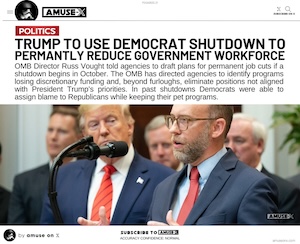
The Office of Management and Budget (OMB), under Director Russ Vought, issued a memo on September 24, 2025, directing federal agencies to prepare “reduction-in-force” (RIF) plans for a potential government shutdown starting October 1, 2025.
DOGE: If Democrats shutdown the government in October Trump has ordered Russ Vought to permanently eliminate jobs when discretionary funding lapses and no alternative funding source is available. In past shutdowns Democrats have been able to assign blame to Republicans and face… pic.twitter.com/gbQkSz39d3
— @amuse (@amuse) September 25, 2025
These plans would involve permanent job eliminations—not just temporary furloughs—for employees in programs, projects, or activities reliant on discretionary funding that lapses without congressional action or an alternative funding source (such as mandatory appropriations).
The memo explicitly ties this to President Trump’s priorities, sparing jobs in areas like border security, immigration enforcement, national defense, Social Security, Medicare, veterans’ benefits, military operations, law enforcement, and air traffic control, while targeting others deemed “not consistent” with those goals.
This approach uses the shutdown threat as leverage to accelerate broader workforce reductions, aligning with Vought’s long-standing advocacy for shrinking the federal bureaucracy (as outlined in Project 2025 and prior Trump administration efforts).
Democrats, including Senate Minority Leader Chuck Schumer and House Minority Leader Hakeem Jeffries, have condemned it as an intimidation tactic and illegal overreach, predicting court challenges (similar to reversals of earlier Trump-era firings via Schedule F or DOGE initiatives). However, the administration views it as a strategic “checkmate” to force concessions on spending bills, with Trump publicly backing the House GOP’s “clean” continuing resolution while refusing broader negotiations.
A shutdown now appears likely, given stalled talks and the midnight September 30 deadline.
Can he do it? Probably not.
However, under longstanding federal law and Office of Personnel Management (OPM) guidance, a government shutdown triggered by a lapse in appropriations does not authorize the permanent firing (or “reduction in force,” RIF) of federal employees as a direct consequence of the shutdown itself.
Federal employees at risk during a government shutdown are protected by several key pieces of legislation and regulations that govern furloughs, back pay, and job security. Below is a summary of the primary legal protections relevant to the scenario described:
Antideficiency Act (31 U.S.C. § 1341–1342):
- Prohibits federal agencies from spending or obligating funds without congressional appropriations, triggering furloughs for non-essential employees during a shutdown.
- Allows “excepted” employees (e.g., those in national security, law enforcement, or public safety) to work unpaid but does not permit permanent terminations due to funding lapses.
- Ensures shutdowns result in temporary furloughs, not firings, for affected employees.
Government Employee Rights Act of 2019 (Public Law 116-1):
- Guarantees retroactive pay for all federal employees—furloughed or excepted—immediately after a shutdown ends, regardless of duration.
- Ensures back pay at the earliest practicable date once Congress restores funding, protecting employees from financial loss.
Merit System Principles (5 U.S.C. § 2301):
- Mandates that federal personnel actions, including any reduction-in-force (RIF), be fair, equitable, and based on job-related criteria.
- Prohibits arbitrary or politically motivated firings, providing a basis for challenging shutdown-related terminations.
Reduction-in-Force Regulations (5 C.F.R. Part 351):
- Governs permanent job eliminations (RIFs), requiring agencies to justify cuts due to budget, reorganization, or lack of work.
- Mandates at least 60 days’ notice (or 30 with OPM approval), competitive ranking, and appeal rights, ensuring due process.
- Shutdowns do not qualify as a valid RIF trigger, making the proposed firings legally questionable.
Civil Service Reform Act of 1978 (5 U.S.C. § 1101 et seq.):
- Establishes the Merit Systems Protection Board (MSPB), where employees can appeal RIFs or adverse actions within 30 days.
- Protects against improper personnel actions, offering a legal avenue to challenge unlawful terminations.
Federal Employee Health Benefits (FEHB) Program (5 U.S.C. § 8905):
- Ensures furloughed employees retain health insurance coverage during a shutdown, with premiums deducted from back pay post-resolution.
These laws collectively ensure that federal employees cannot be permanently fired solely due to a shutdown, must receive back pay, and have due process rights to challenge terminations. The OMB’s proposed RIFs during a shutdown would likely violate these protections, particularly the Antideficiency Act and RIF regulations, and face legal challenges, as noted by experts and Democratic leaders. Employees can also rely on union representation (e.g., AFGE, NTEU) for grievances and state unemployment benefits during furloughs.